Skyridge·#14·2003
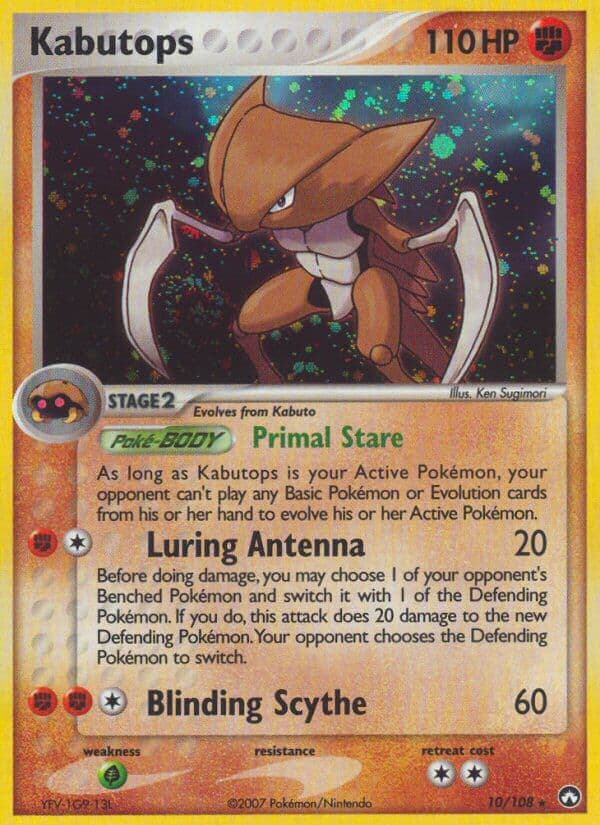
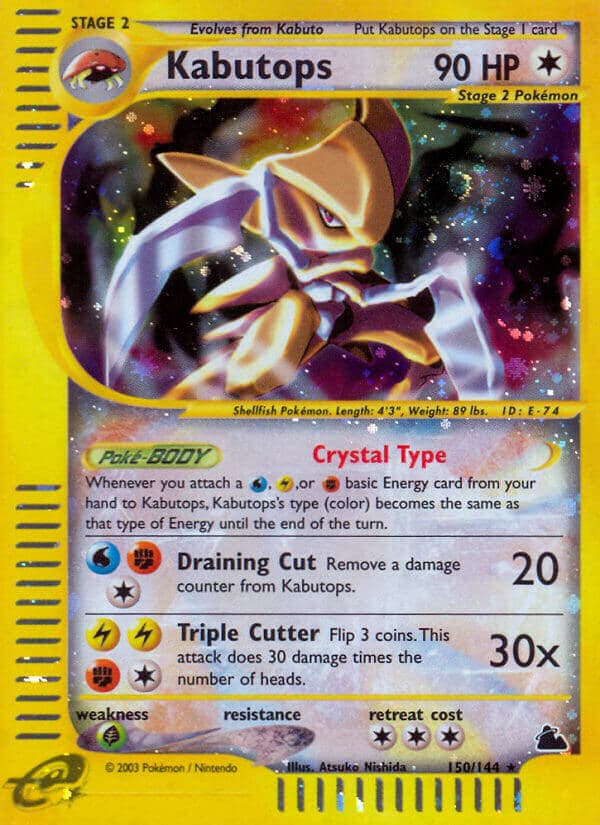
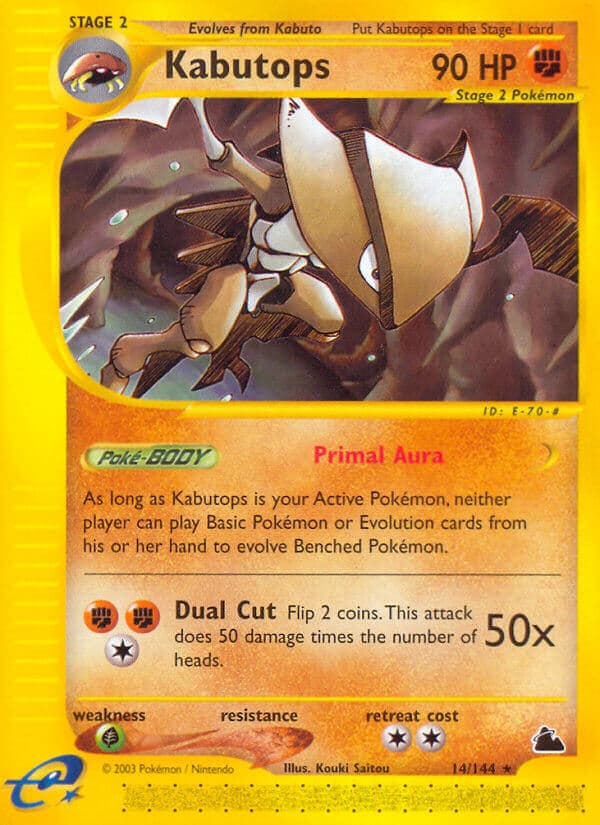
Kabutops is a formidable Rock/Water-type Fossil Pokémon from the Kanto region, known for its scythe-like claws and ancient origins as a predator of the seas, evolving from Kabuto. This particular Kabutops from the 2003 Skyridge set is an uncommon e-Reader card, showcasing its unique abilities and stunning artwork within the final Western set of the Wizards of the Coast era. Here, you will discover its rich Pokédex lore, detailed battle mechanics including its powerful attacks and energy costs, and a comprehensive history of this specific edition.
Read more ↓Kabutops is a Rock/Water-type Fossil Pokémon, an ancient creature brought back to life from the Dome Fossil. Introduced in Generation I, alongside its pre-evolution Kabuto, it represents a fascinating glimpse into prehistoric Pokémon life. Kabutops is characterized by its scythe-like claws, streamlined body, and a hardened shell, all adaptations for its life as a swift and deadly marine predator. Its natural habitat, when it roamed ancient seas, would have been coastal waters and deep oceans where it hunted for prey, likely using its sharp claws to slice and dice. In the anime, Kabutops often appears in episodes dealing with ancient Pokémon or fossil resurrections, emphasizing its prehistoric nature. It has a notable role in the Pokémon Red, Blue, and Yellow games as one of two possible fossil Pokémon players can revive, with Omastar being the alternative. As a Rock/Water type, Kabutops has a unique set of type matchups; it is strong against Fire, Flying, Bug, and Ice types due to its Rock typing, and against Fire, Ground, and Rock types due to its Water typing. However, it is weak to Electric and Grass types (doubly so for Grass due to both typings), as well as Fighting and Ground types. Its design and lore contribute significantly to the Pokémon world's depth, offering a window into its ancient ecosystems and the concept of resurrection through science. Its aggressive and predatory behavior is a consistent theme across its various appearances.
Last updated: April 11, 2026